
We are the Media Authority of North Rhine-Westphalia
We are committed to freedom of expression.
As an independent regulatory authority for private broadcasting and telemedia in North Rhine-Westphalia, we have a statutory mandate. Our role is to safeguard a democratic media system—one that upholds freedom of expression and protects human dignity, young people, and users, while promoting media diversity.
Protecting Human Dignity
Human dignity is inviolable. This is enshrined in the first article of our Constitution, and it should really go without saying. Yet in the media - and especially on the internet - it is all too often violated, and this fundamental right is infringed upon; depictions of violence, incitement to hatred, and criminal forms of hate speech are examples of such violations. We are committed to ensuring that such violations are identified, removed, and their authors prosecuted. In this way, we fight to protect human dignity - including through the use of artificial intelligence.
Protecting Minors
Pornography is not for children. Yet it is often freely accessible online. We work to ensure that children and young people are protected from such content. We also help young people find guidance in an online world that only appears to have no boundaries.
We make it easy to report crimes such as cybergrooming. We ensure that providers comply with the law. After all, children have the right to use the internet freely and without fear. This is how we put effective youth protection into practice.
Procting Users
We are committed to protecting the democratic media system. That sounds great but what does the media have to do with democracy? In fact, quite a lot! The media inform us about current events, provide a forum for public debate, and help shape our understanding of the world. They play a crucial role in how we live together in a democracy, how citizens form opinions, and ultimately how political decisions are made.
That is why it is a problem when people are misled by media content. Here, you can learn how we protect users, combat disinformation and undisclosed advertising, where to find help with questions about everyday media use, and how we are addressing the opportunities and challenges of artificial intelligence.
Protecting Diversity
Protecting, promoting, and developing diversity in North Rhine-Westphalia as a media hub—that is one of our core missions. Democracy needs media diversity, which is why we support media professionals and assist editorial teams and media companies in developing innovative offerings in North Rhine-Westphalia. Through our traineeship program, we provide a versatile entry point into the best industry in the world—and help people in North Rhine-Westphalia to actively participate in the conversation and publish their work. This is how we ensure the protection of diversity.
We combat hate and digital violence and work to ensure that the internet remains a free and, above all, safe space free from fear, including for children and young people. We support digitalisation and new technologies. We conduct scientific research that helps us fulfil our mandate and provides valuable insights for policymakers, educational institutions, and market participants.
We are committed to ensuring that media regulation in North Rhine-Westphalia, Germany, and Europe keeps pace with the times. We promote and strengthen media diversity in North Rhine-Westphalia. We make media participation more accessible, provide guidance on media use, and offer support when questions or problems arise.
At the same time, we keep a close eye on compliance with applicable law whenever media services are created and used. Today's world offers an unprecedented level of freedom. We must preserve that freedom, and we must protect it.
We are convinced that defending our democratic constitutional order requires the commitment of every citizen and a great deal of courage, time and again. Through our work, we play our part in that effort.
More Information
We were founded in 1987 as the State Broadcasting Authority of North Rhine-Westphalia (Landesanstalt für Rundfunk Nordrhein-Westfalen, LfR) under the Broadcasting Act for the State of North Rhine-Westphalia (Landesrundfunkgesetz, LRG NW). On 31 July 2002, a new State Media Act (Landesmediengesetz, LMG NRW) came into force, which also included a change of name for the authority. Since then, we have been known as the Media Authority of North Rhine-Westphalia (Landesanstalt für Medien Nordrhein-Westfalen, LFM), and since July 2018 as the Media Authority of NRW (Landesanstalt für Medien NRW). Our headquarters are located in Düsseldorf.
Part of "die medienanstalten"
The 14 media authorities in Germany cooperate on key tasks and projects under the umbrella brand “die medienanstalten”.This ensures that private radio and television stations nationwide are regulated uniformly and that the media authorities speak with one voice in European media policy. The media authorities operate on the basis of the State Media Treaty, as well as the State Treaty on the Protection of Minors in the Media, state media laws, and the AVMSD.
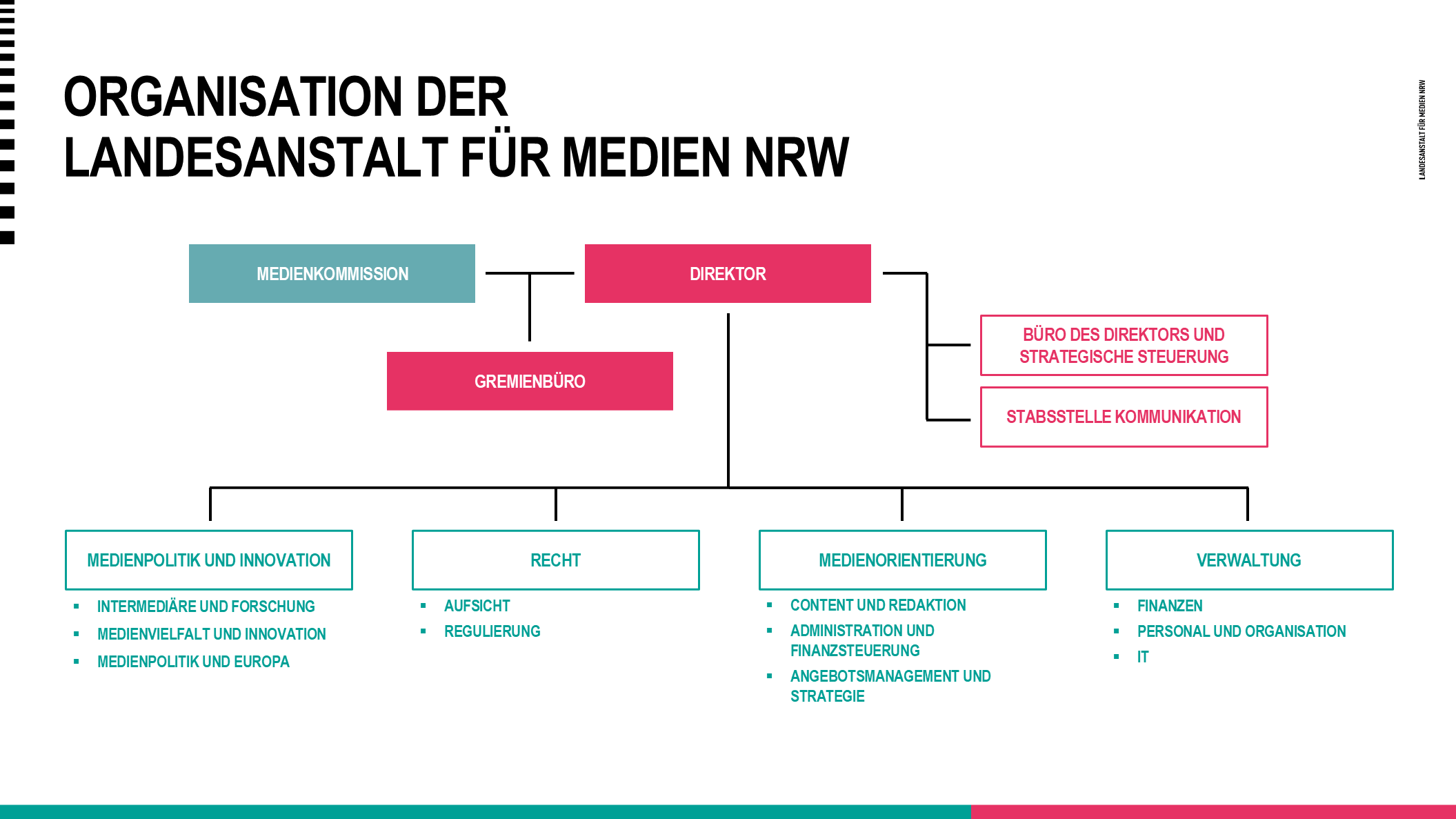
Director and executives

Director
Dr Tobias Schmid

Head of Finance
Vanessa Kehm

Head of Human Resources
Markus Kamps
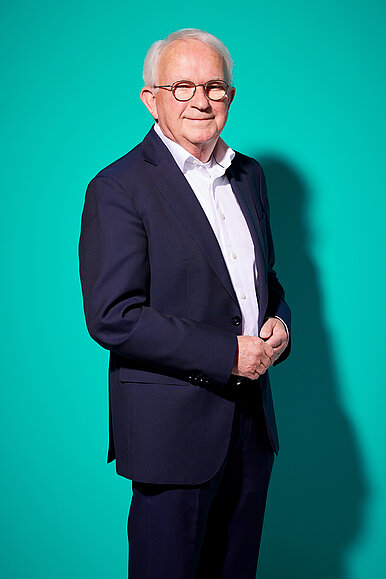
Chair of the Media Commission
Prof Dr Werner Schwaderlapp

Head of Administration
Michael Dimitrov

Head of Media Education
Sabrina Nennstiel

Deputy Director
Dr Petra Gerlach
Head of Media Policy and Innovation

Head of Communications
Marie-Franca Hesse

Head of the Committee Office
Thomas Fritz

Head of Media Diversity and Innovation
Simone Jost-Westendorf

Head of Intermediary Services and Research
Dr Meike Isenberg

Head of Legal Affairs and General Counsel
Dr Laura Braam

Head of the Director's Office and Strategic Management
Nele Nieuwenhuis
Legal Basis for Our Work
As a public broadcaster, we are independent of the state and private interests. The legal basis for our work is the North Rhine-Westphalia State Media Act (LMG NRW) and, among other things, the State Media Treaty (MStV). With regard to issues concerning the protection of minors in the media, the State Treaty on the Protection of Minors in the Media (JMStV) is authoritative.
However, broadcasting and internet services cannot be confined to the borders of the federal states. Although broadcasting is—in principle—a matter for the states under the Basic Law, the state media authorities have organized some of their tasks jointly. They collaborate in various decision-making bodies, particularly on issues of supraregional significance. This ensures that decisions of cross-state or supraregional significance are made and addressed in a coordinated manner. In addition, other directives, agreements, and conventions at the European level also play a role.